

Faculty
Faculty of Computing
Software, data and security: the disciplines behind every modern service, taught in well-equipped laboratories with industry projects from the first year.
- 5 degree programmes
- 250 pioneer places
- 5 departments
About the faculty
Welcome to the Faculty of Computing
The Faculty of Computing brings together the five disciplines that build and protect the digital world: Computer Science, Software Engineering, Cyber Security, Information Technology and Data Science. All five share a common first year, so every student gains a solid grounding in programming, mathematics and problem solving before specialising.
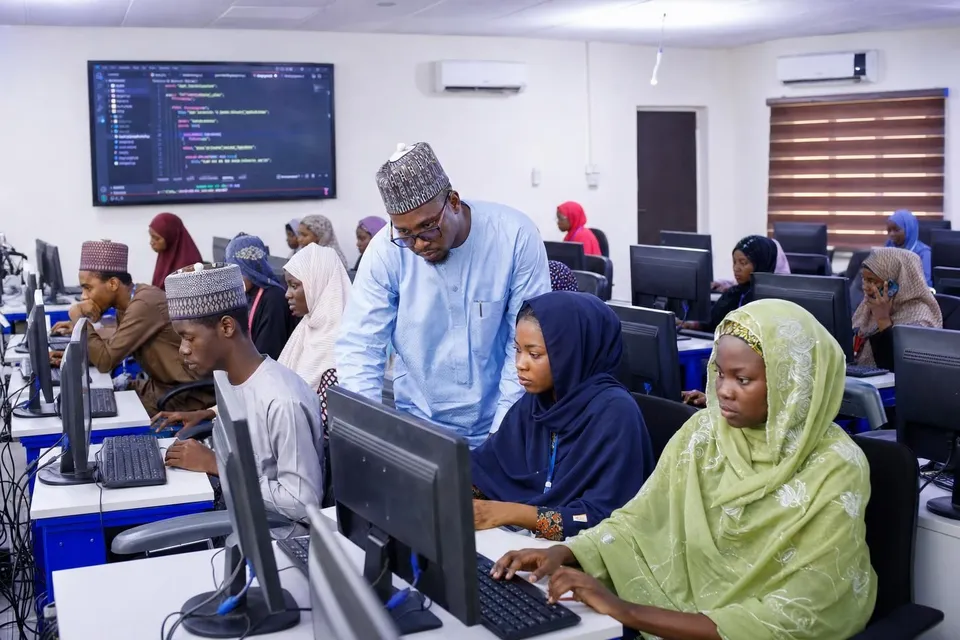
Teaching is intensely practical. Students write code from the first week in a laboratory with one workstation each, take part in team projects and hackathons in the innovation hub, and spend six months in industrial training with software companies, banks, telecommunications operators and public agencies.
The Faculty works with employers to keep its curriculum current, with artificial intelligence, cloud computing, mobile development and security built into the core rather than left as optional extras.
- Degree programmes
- 5 Degree programmes
- Pioneer places
- 250 Pioneer places
- Networked workstations
- 120 Networked workstations
- Months of industrial training
- 6 Months of industrial training
Structure
Departments
Each department is led by a Head of Department and runs its own programme or programmes.
Study with us
Degree programmes
All programmes admit UTME and Direct Entry candidates for the 2026/2027 session.
Computer Science
Computing
The science of computation and software: algorithms, programming, systems and artificial intelligence, taught through projects from the first semester.
Software Engineering
Computing
The engineering discipline of building reliable software: requirements, design, testing, delivery and maintenance of real systems in teams.
Cyber Security
Computing
Protecting systems, networks and data: cryptography, network defence, digital forensics and ethical hacking in a dedicated security laboratory.
Information Technology
Computing
Designing, running and supporting the systems organisations depend on: networks, cloud services, databases and digital government.
Data Science
Computing
Turning data into decisions: statistics, machine learning, data engineering and visualisation, applied to health, agriculture, finance and government.
Where you will learn
Laboratories and facilities
- ICT laboratory with 120 networked workstations
- Innovation hub with robotics, drone and IoT kits
- Isolated cyber security laboratory
- Networking laboratory with routers, switches and servers
- GPU workstation for machine learning
- Campus-wide fibre and wireless network


Admissions 2026/2027
Become a pioneer student of the Faculty of Computing.
250 places across 5 programmes. Applications close on 19 December 2026.