

Research and innovation
Research at Fortune University
Research that answers the questions of the North-East: how to feed, heal, power, connect, govern and educate a fast-growing region.
Our approach
Research with a purpose
A university is measured not only by what it teaches but by the knowledge it creates. From its first session, Fortune University will expect its academic staff to be active scholars, and will give them the time, funding and facilities to do research that matters.
Our research will be problem-led. Bauchi State and the North-East face some of the most pressing development challenges in Nigeria: food security in a changing climate, maternal and child health, energy access, youth employment, and peace and security. These are the questions our faculties are best placed to study, and where good research can make a visible difference.
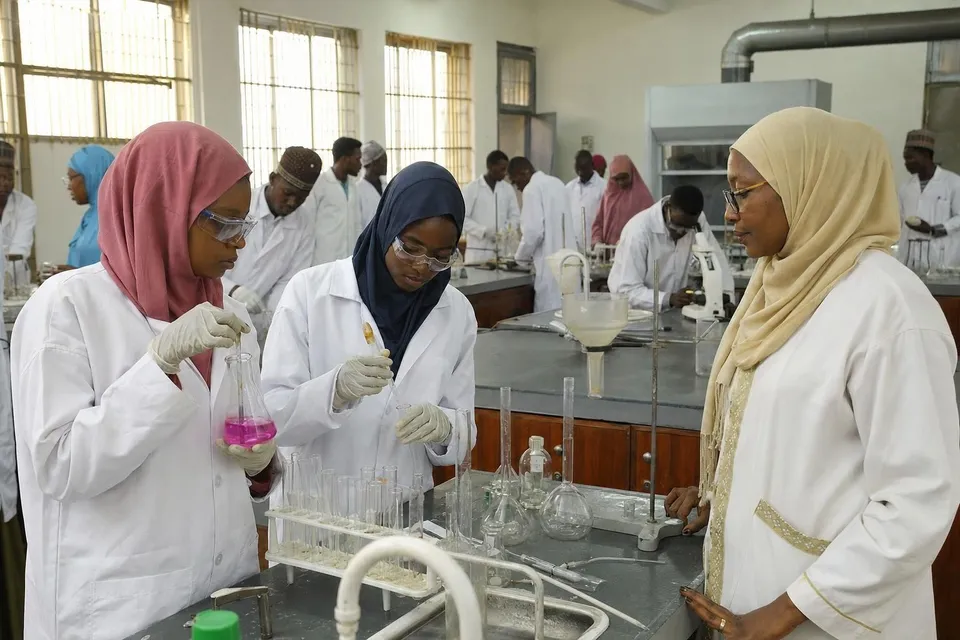
We will also be practical. Students will take part in research from their early years, through laboratory projects, community surveys and final-year dissertations linked to the University's priority areas.
A young university
Fortune University was licensed in October 2026 and does not yet have a research record of its own. This section sets out our research priorities, policies and plans, and will report our projects and publications as they begin.
Where we will focus
Priority research areas
Six areas, chosen for their importance to the region and the strengths of our five faculties.
Natural and Applied Sciences
Dryland agriculture and food security
Drought-tolerant crops, soil and water management, post-harvest losses and the processing of sorghum, maize, groundnut and legumes.
Allied Health Sciences
Public health and nutrition
Maternal and child health, malnutrition, infectious disease surveillance and access to primary health care in rural communities.
Natural and Applied Sciences
Renewable energy and climate
Solar mini-grids, energy-efficient buildings, desertification and the adaptation of farming communities to a changing climate.
Computing
Digital inclusion and cyber security
Mobile and digital services for rural users, local-language technology, data protection and the security of public systems.
Management and Social Sciences
Peace, security and governance
Community security, conflict resolution, local government, public finance and the economics of insecurity in the North-East.
Education
Education and learning
Science and mathematics teaching, girl-child education, out-of-school children and the use of technology in classrooms.
Support for researchers
How the University will support research
-
1
Vice-Chancellor's Seed Grants
Competitive internal grants of up to ₦2 million for early projects in the priority areas, with preference for teams that include students and community partners.
-
2
Time to research
Teaching loads set to leave time for research, and a sabbatical scheme for senior staff once the University reaches its fourth session.
-
3
Help with external funding
A Research and Grants Office in the Directorate of Academic Planning to help staff find, write and manage applications to national and international funders.
-
4
Conferences and publication
Support for conference travel and for publication in reputable, peer-reviewed journals; no support for predatory journals or conferences.
-
5
Shared facilities
Central laboratories, the research greenhouse and teaching farm, and high-performance computing in the ICT centre, open to all departments.
Integrity
Ethics and research integrity
Research involving people, animals or personal data must be approved by the University's Research Ethics Committee before it begins. The Committee follows national guidelines for health research ethics and the Nigeria Data Protection Act 2023.
Plagiarism, fabrication and falsification of data are serious misconduct for staff and students alike. Every thesis and staff publication is checked with similarity-detection software.
- Informed consent in the local language for community research
- Secure storage of research data, with personal data minimised
- Fair credit for students and community partners in publications
- Open access for research outputs wherever funders allow
Get involved
Centres, partnerships and collaboration
See the research centres the University plans to establish, and how organisations can work with us.