
Faculty of Natural and Applied Sciences
B.Sc. Industrial Chemistry
Chemistry for industry: chemical processes, analysis, quality control and the conversion of local raw materials into useful products.
- B.Sc.
- 4 years full-time
- Full-time, on campus
- Starts 8 February 2027
About the programme
Industrial Chemistry at Fortune University
Industrial Chemistry combines the core branches of chemistry (organic, inorganic, physical and analytical) with the processes by which chemicals are made on a commercial scale. You will learn unit operations, process calculations, quality control and the safe handling of chemicals.
The programme looks closely at the raw materials of the region, including limestone, clays, kaolin, oil seeds and agricultural produce, and at how they can be processed into fertilisers, paints, soaps, building materials and foods. Industrial training gives you direct experience in manufacturing plants.
Why Fortune
Why study Industrial Chemistry with us
- Strong practical training in chemical analysis and instrumentation
- A focus on value addition to the minerals and farm produce of the North-East
- Courses in quality control, safety and environmental management that industry requires
- Six months of industrial training in cement, food, paint or petrochemical companies
Admission
Entry requirements
A UTME score of at least 150 is required, with the subjects below. Candidates are also screened by the University before admission.
UTME subjects
- 1 Use of English
- 2 Chemistry
- 3 Mathematics
- 4 Physics or Biology
O'Level
Five credit passes in SSCE (WAEC or NECO) or NABTEB, in not more than two sittings, including English Language, Mathematics, Chemistry and Physics, and one of Biology, Agricultural Science or Further Mathematics.
Direct Entry
Two A Level, IJMB or JUPEB passes in Chemistry and Physics or Mathematics; or a National Diploma (Upper Credit) or Higher National Diploma in Science Laboratory Technology (Chemistry option) or Chemical Engineering Technology. Direct Entry candidates join at 200 Level.
Programme length for Direct Entry: 3 years
Curriculum
What you will study
An indicative outline of the core courses at each level, based on the NUC Core Curriculum and Minimum Academic Standards (CCMAS). Elective courses are chosen with your level adviser; the full course list is approved each session by the Senate.
100 Level
11 courses · 21 units| Code | Course title | Units |
|---|---|---|
| CHM 101 | General Chemistry I | 2 |
| CHM 102 | General Chemistry II | 2 |
| CHM 107 | General Practical Chemistry I | 1 |
| PHY 101 | General Physics I | 2 |
| PHY 102 | General Physics II | 2 |
| PHY 107 | General Practical Physics I | 1 |
| MTH 101 | Elementary Mathematics I | 2 |
| MTH 102 | Elementary Mathematics II | 2 |
| COS 101 | Introduction to Computing Sciences | 3 |
| GST 111 | Communication in English | 2 |
| GST 112 | Nigerian Peoples and Culture | 2 |
| Core units | 21 |
After graduation
Where it can take you
Professional recognition
Graduates are eligible to register with the Institute of Chartered Chemists of Nigeria (ICCON) and to join the Chemical Society of Nigeria (CSN). Professional recognition of the programme will be sought at the appropriate stage.
Where you will learn
Facilities
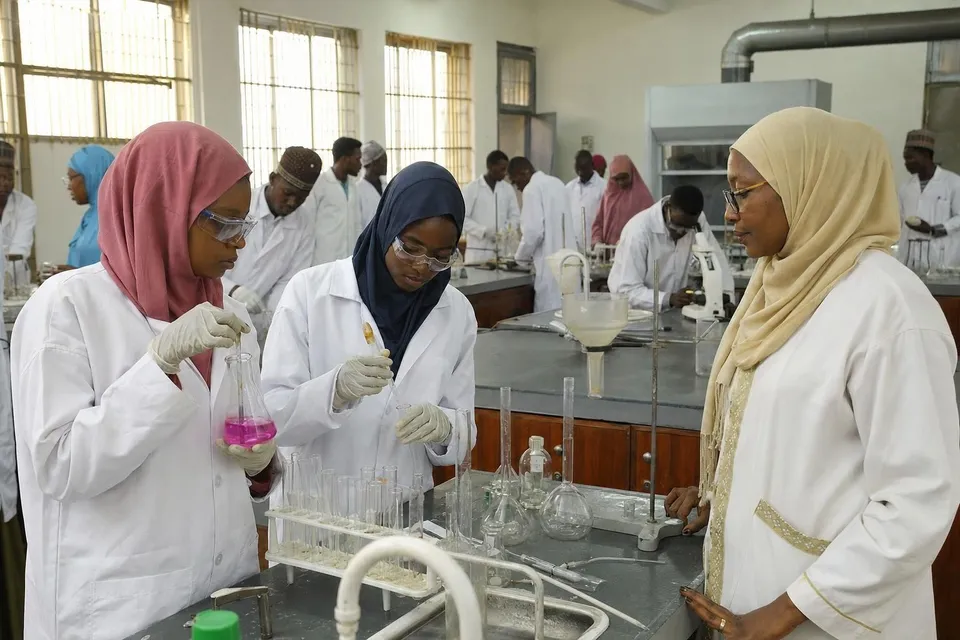
- Chemistry teaching laboratories with fume hoods
- Pilot-scale process laboratory
- Instrument room with spectrophotometers and a gas chromatograph
- Chemical store with safety systems
Also in Natural & Applied Sciences
Related programmes
Biochemistry
Natural & Applied Sciences
The chemistry of life: enzymes, metabolism, molecular biology and their use in medicine, nutrition, agriculture and industry.
Microbiology
Natural & Applied Sciences
Bacteria, fungi and viruses: how they cause disease, preserve and spoil food, clean the environment and power industry.
Physics with Electronics
Natural & Applied Sciences
Physics with a practical edge: electronics, instrumentation, embedded systems, telecommunications and renewable energy.
Admissions 2026/2027
Join the pioneer class in Industrial Chemistry.
40 places are available in the 2026/2027 session. Applications close on 19 December 2026.